December 29, 2025
When the noise of Christmas celebrations begins to fade and the excitement of New Year’s slowly settles, in Italy people wait for one last magical finale.
On the night between January 5th and 6th, the air is no longer filled with the expectation of Santa Claus — who has already done his job and delivered gifts to children around the world — but with the presence of a much older and, in many ways, more complex figure: the Befana.
Far from the polished, global image of her red-clad counterpart, the Befana is an archetype deeply rooted in Italian folklore. A kind old witch riding a broom, always wearing her signature headscarf, she doesn’t inspire fear — she brings gifts and marks the true end of the holiday season.
Her celebration, known as Epiphany, is a unique blend of Christian tradition and ancient folk legend. The biblical story of the Three Wise Men visiting baby Jesus is inseparably woven together with a tale that comes from much older roots. But who exactly is this mysterious night-time figure, and why does her legend still captivate generations of Italians, resisting the uniformity of global holidays?
The unmistakable image of the Befana
The Befana’s image is instantly recognisable in the Italian imagination. She is an elderly woman with kind, wrinkled features, a crooked nose and a pointed chin. Her clothing is the opposite of luxury: worn, dark, patched-up clothes, wrapped in old shawls to protect her from the cold of her night flights. On her head, a scarf. On her feet, thick stockings and worn shoes.
She doesn’t travel in a sleigh pulled by reindeer, but on a simple, battered broom made of twigs, flying from rooftop to rooftop and slipping down chimneys. And even if she looks like the witches of fairy tales, the Befana is never evil.
She is more like a magical grandmother — a little gruff, but deeply generous — carrying a sack filled not just with gifts, but with meaning. Even her name reveals her origins: Befana comes from a popular distortion of the Greek word Epiphany, meaning “appearance” or “manifestation,” showing her deep connection to the religious feast of January 6th.
The origins of the legend
The best-known story about her is deeply human and directly tied to the Gospel. According to legend, the Three Wise Men, following the Star of Bethlehem, knocked on the door of a small house asking for directions. An elderly woman answered — the Befana — busy sweeping her floor with careful attention.
Impressed by her wisdom, the Wise Men invited her to join them to honour the newborn King. But she refused. Too proud, too focused on her chores, she said she couldn’t leave her house untidy. And so they left, and she went back to cleaning.
Soon after, however, she was filled with regret. Realising she had missed something extraordinary, she prepared a basket of sweets and gifts, grabbed her broom and flew into the night to search for the Child. Unable to find Him, she began stopping at every home, leaving gifts for every sleeping child — hoping one of them might be the baby she had failed to honour.
And so, every year on January 6th, she continues her endless search.
The meaning of the stocking and the gifts
Children hang an empty stocking on the night of January 5th. During the night, the Befana fills it with sweets, dried fruit and small toys for those who have behaved well. For the naughty ones, she leaves coal.
But this coal was once a positive symbol — in ancient pagan traditions it represented fertility, renewal and the energy of fire for the new year. Only later did it become a gentle warning for mischief.
Unlike Santa, the Befana doesn’t receive wish lists. Her gifts are simple and small — gestures of affection rather than consumerism.
The broom as a symbol of renewal
The broom is not only for flying. Legend says the Befana also sweeps the house before leaving. This is symbolic: she sweeps away the troubles and negativity of the past year, preparing the home for a fresh start.
This connects her to ancient rituals of renewal tied to the winter solstice. That’s why in Italy people say:
“Epiphany takes all the holidays away.”
Her visit closes the festive season and opens the door to the new year.
What the Befana’s scarf really means
A headscarf has always been more than an accessory. It is a symbol of protection — from cold, sun, dust and wind, but also from what cannot be seen.
In Italian culture, a scarf told your story: your age, your social status, even your region. The way it was tied was a personal signature.
It also meant dignity. It belonged to women who worked, who lived, who didn’t need to be seen to exist.
The Befana wears a scarf because she represents a woman who has lived. Not a princess — but a wise, maternal figure moving through time.
Barbieri Silk Scarves — the perfect Epiphany gift
Epiphany is when you think of the women who matter most: a mother, a grandmother, a sister, a friend. A scarf is perfect. It’s gentle, not intrusive — but meaningful.

A Barbieri silk scarf can be worn on the hair, around the neck, tied to a bag. It changes, just like the woman who wears it.
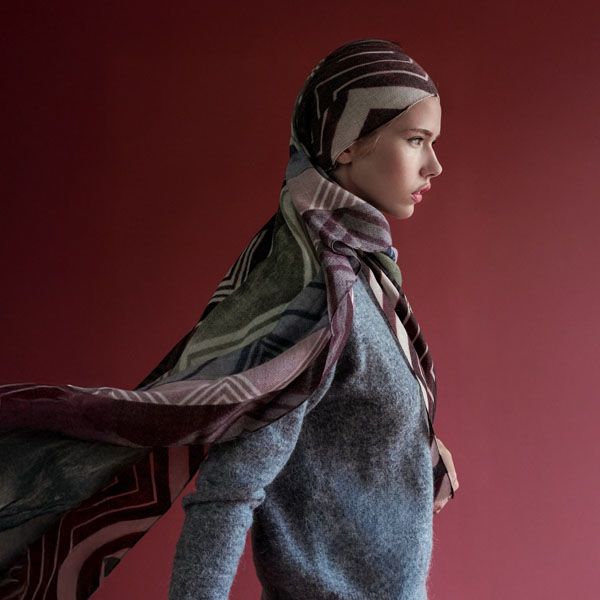
What does a woman really wear when she ties a silk scarf on her head? Sometimes it’s a crown — made of silk instead of gold. Sometimes it’s a soft helmet that shields her from the noise of the world.
Often, it’s a flag — declaring who she is without a word.

This simple gesture carries a legacy: elegance without excess, independence without noise, beauty as a choice.
Micaela Corallo – Designer at Barbieri 1945
Discover Barbieri scarves and fall in love with their bold colours.