The silk twilly, also known as a mini scarf, silk ribbon or skinny silk scarf, is one of those accessories that may seem simple at first glance, but in reality carry a rich history, artisanal tradition and surprising versatility. Born as a natural evolution of the classic silk scarf, it differentiates itself in both shape and purpose: slimmer, longer, more dynamic.
Yet its soul remains unchanged: refined silk, artistic prints, vibrant colours, and that understated elegance that doesn’t need to be announced.
The refined origins of the silk twilly: an evolution of sericultural tradition
The twilly finds its roots in the history of the French silk scarf, especially within the heritage maisons that first established printed silk as a symbol of sophistication. Between the 1930s and 1950s, the scarf became an icon of the feminine wardrobe, tied around the neck in countless creative ways. By the late 1950s, narrower and more elongated versions began to appear—precursors of what we now know as the twilly.
The real turning point arrived in the 1960s, when fashion began seeking accessories that were playful, versatile, and capable of transforming a look with a single effortless gesture. During this period, maisons adopted slender silk formats designed for hairstyles, wrists, and handbag handles.
In the 1990s, Hermès officially codified the name “Twilly”, elevating it to an iconic accessory: an elegant yet informal silk ribbon capable of expressing personality through knots, ties and colour combinations. Its popularity skyrocketed in the 2000s, driven by street style and digital fashion, until it became the genderless, creative accessory we know today.
There is, however, a place where silk is more than a fabric — it is a language: Como. From this cradle of excellence, Barbieri draws inspiration for a collection of twillies that are pure textile poetry.
Every creation is a forward-thinking stylistic vision. Wearing a Barbieri twilly means choosing a kind of timeless luxury — a piece of Italian heritage that continues to evolve, weaving colour and design into a signature gesture.

colors twilly
Today, the silk twilly is more than just a skinny scarf: it is a style language of its own, interpreted differently by each person who wears it.
A woman’s day with her silk twilly: a thousand ways to wear it
To understand the charm of the twilly, imagine an ordinary day in the life of a woman working in the city. A woman who values comfort but still wants a detail that reminds her of who she is, even when routine becomes overwhelming.
In the morning, as she gets ready for the office, she chooses a simple outfit: a crisp shirt, a structured blazer and a dark skirt. She wants to feel professional, yes, but still herself. She opens the drawer of accessories and takes her favourite Barbieri silk twilly — slim, luminous, with prints that reflect her personality.
With a quick gesture she ties it around her neck, letting the ends fall asymmetrically. In those few centimetres of pure silk, she feels an instant touch of originality and charm that balances the formality of her outfit.
Throughout the morning, while writing emails or attending meetings, the twilly stays there — a quiet presence that gives her a natural sense of elegance, like a subtle detail that requires no attention yet makes her feel “right”.
At lunchtime, when the sun brightens the city streets, she steps outside wearing large sunglasses, her phone in her bag, and the desire for a breath of fresh air. With the warm light and a gentle breeze tousling her hair, she spontaneously loosens the twilly from her neck and ties it into her hair as a silk headband.
It’s an instinctive, almost playful gesture: instantly, the look becomes lighter, summery, relaxed and carefree.
The silk, soft and cool against her skin, catches the sunlight and adds that touch of femininity that never goes unnoticed, yet never feels excessive.
The afternoon rushes by — work, an appointment, one last email. But the true magic happens in the evening, when she meets friends for dinner.
She wears an elegant dress, a burgundy sheath with an open back. Looking in the mirror, she feels something is missing. She opens her bag and finds her twilly — nothing more is needed.
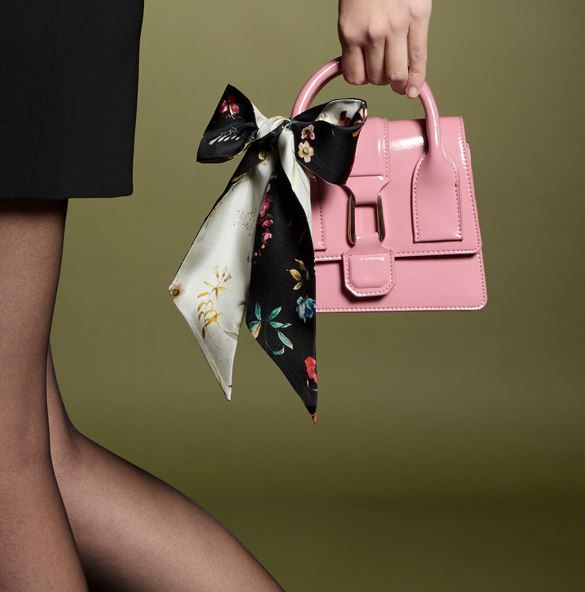
She ties it around the handle of her handbag, letting the ends fall like a colourful smile. In an instant, the smallest accessory becomes the defining element of her entire look.
It’s a simple gesture, yet that is the power of silk: it transforms, adapts, reinvents itself.
And so, the same mini scarf accompanies her through three different moments of the day, becoming a narrative accessory — alive, expressive, capable of telling her story better than many other pieces in her wardrobe.
Why the silk twilly has returned to centre stage
The twilly’s success is not based on aesthetics alone: it stems from its creative versatility — the ability to be worn around the neck, in the hair, on the wrist, on a handbag, as a slim belt, or as a decorative detail.
But there is something deeper, too.

A silk twilly — especially when crafted from fabrics produced in traditional districts such as Como — carries a heritage of exceptional quality you can feel: in the brilliance of the colours, the care in printing, and the lightness that only natural silk can offer.
It is an accessory that speaks of conscious taste, but also of freedom: it does not impose a single way to wear it — it suggests possibilities. It is a tool of self-expression, never a constraint. And perhaps this is its secret: a small scarf that asks for little yet gives so much more.
Let yourself be inspired and choose the Barbieri silk twilly that speaks to you.