February 9, 2026
The Venice Carnival is one of Europe’s oldest and most fascinating cultural and artistic events—a kind of collective ritual that for centuries has embodied the very essence of the lagoon city: elegance, mystery, and theatricality. Its origins date back at least to the 12th century, in a civic context in which the Serenissima Republic aimed to create moments of celebration and social cohesion in the days leading up to Lent, when people allowed themselves a temporary suspension from the strict rules of everyday life.
In this kaleidoscopic interplay between devotion and transgression, between the sacred and the profane, masks, sumptuous costumes, and the most precious fabrics dictate the unwritten laws of carnival aesthetics—and among the most celebrated materials of this ritual is silk itself, an aristocratic fiber and a symbol of luxury, culture, and craftsmanship.
The unbreakable bond between silk and the Venice Carnival, however, is not merely aesthetic but narrative: it tells the story of a city that, at the height of its splendor, elevated fashion to the level of art.
Venetian Silk: From Cosmopolitan Trade to Carnival Haute Couture
To understand the importance of silk in the Venice Carnival, one must step back into the economic and cultural history of the Serenissima, among the most dynamic trading powers of the Mediterranean.
As early as the Middle Ages, Venice established itself as a central hub of the international trade in precious textiles, thanks to its network of commercial relations with Byzantium, the Near East, and—via the Silk Road—far-off cultural centers such as China.
Stories and documents recount the arrival of early silk-making knowledge in Venice through Byzantine artisans and workshops, as well as the founding in the 13th century of the “samiteri” guild—the weavers of precious fabrics such as samites, brocades, and velvets. These luxurious textiles, often embellished with gold and silver threads, became synonymous with prestige and social distinction: fabrics destined to appear in courtly garments, at aristocratic festivities, and in public ceremonies such as the Carnival.
Over the following centuries, Venice maintained its supremacy in silk production and trade, flourishing particularly during the Renaissance and through the 17th century, when the city was considered one of the most important silk-textile centers in the Western world.
This history is not merely an economic fact: it is the invisible thread that accompanied the evolution of Venetian costumes—those sumptuous garments that shaped the globally recognized visual identity of the Venice Carnival.
Masks and Silk: The Aesthetics of Carnival
Swimsuit crafted using one of the iconic Foulard Design prints from our collection.
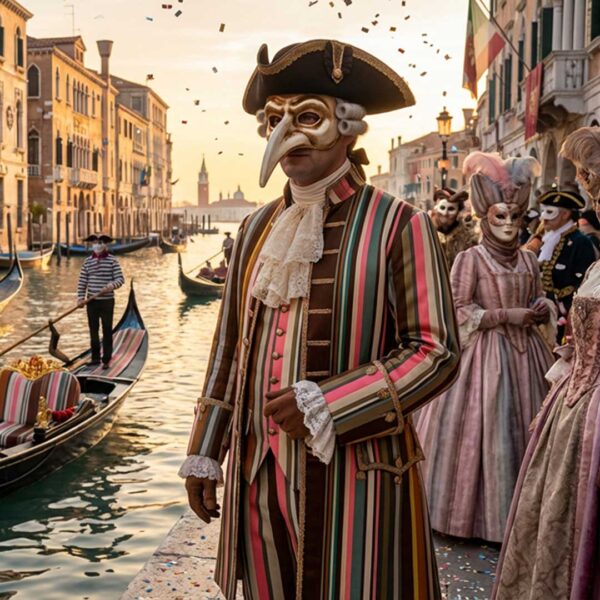
The Venetian Carnival is not simply a street celebration but a vast, open-air theater in which every participant becomes a protagonist. Masks—an iconic element of the event since its beginnings—conceal identities, blur social boundaries, and above all offer an endless creative space for costume, color, and material.
Among the most famous masks, such as the Bauta—the quintessential face of the Venetian Carnival—and the Colombina, silk plays a central role in the accessories framing the visage: flowing cloaks, precious headdresses, translucent veils, and finely woven gloves.

Swimsuit crafted using the refined Stripe scarf design from our collection.
It is precisely here, in the interplay between mask and costume, that silk finds its highest celebration: it is the fabric that envelops, illuminates, and defines the silhouette. In the Venice Carnival, silk is not merely a raw material but a visual language—an expression of symbolism, art, and storytelling. It lends movement, light, and theatricality to costumes with extraordinary effectiveness, creating that atmosphere suspended between dream and reality that has made the festival famous around the world.
A Living Legacy: From Ancient Tradition to Contemporary Times
After a period of decline between the 18th and 19th centuries, the Venice Carnival was gradually revived in the second half of the 20th century, recovering its historical identity and transforming itself into one of the most eagerly awaited cultural events in the world. Today, enthusiasts and artisans work for months before the official opening to create costumes that celebrate tradition and fantasy—looking not only to the past but also to the present and, above all, to the future.
In this dialogue between old and new, silk retains a central role: not merely a material of the highest quality, but the emblem of that artisanal and sartorial beauty that continues to enchant generations of visitors.
When the lights of Carnival come on in St. Mark’s Square, every piece of silk fluttering in the wind tells a story of trade, elegance, and a city that turned fashion into a collective experience.
The bond between silk and the Venice Carnival is no accident, but the result of centuries of history, culture, and creativity. With its shimmer and lightness, silk embodies the very essence of Venetian aesthetics: a perfect balance between artisanal tradition and visual spectacle, which has made Carnival one of the most evocative icons of Europe’s cultural heritage.
From Costume History to Contemporary Accessories: With Barbieri, Silk Remains the Star of Style
In today’s world, the legacy of the Venice Carnival finds interpreters capable of translating it into a modern language without betraying its soul. Barbieri is one such example—a brand that makes sartorial care and the selection of fine materials its aesthetic manifesto.
In its accessories, silk is not merely an ornament but the protagonist: scarves, foulards, twillies, and kimonos become narrative surfaces, capable of evoking torch-lit calli, gilded palace halls, and the theatrical rustle of eighteenth-century cloaks.
At Barbieri, we reinterpret the allure of Carnival for the present day, offering creations that speak of celebration and mystery with a measured, cosmopolitan elegance—designed for those who wish to carry with them a fragment of that imagery, suspended between dream and reality.
Micaela Corallo – Designer at Barbieri 1945
Let yourself be captivated by the timeless charm of silk and discover firsthand how tradition and contemporary design meet in Barbieri’s collections.